
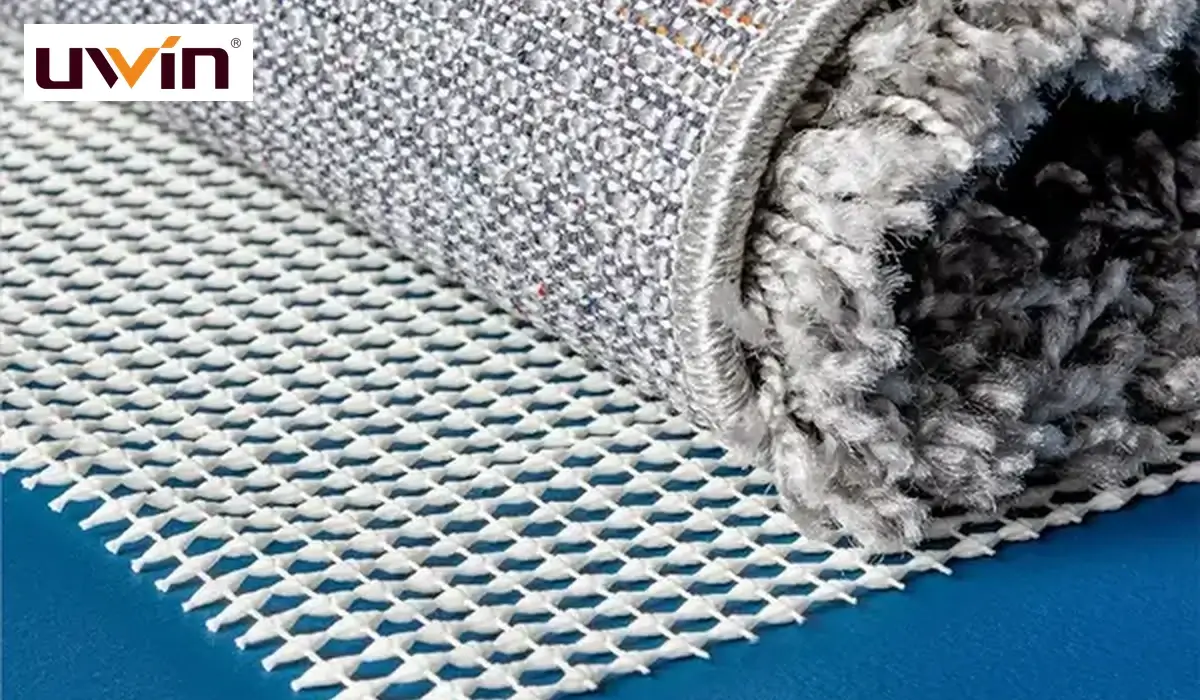
For thin rugs placed on hard floors, low-profile PVC foam mesh or rubber non-slip rug pads are common choices when the primary goal is to reduce sliding. If additional cushioning underfoot is also needed, felt combined with a non-slip backing is a better fit. Area rugs placed over wall-to-wall carpet require an underlay specifically designed for carpeted surfaces.
There is no single material that makes the “best rug underlay” for every product. The right choice depends on the rug’s weight and backing construction, the flooring underneath, and whether the product needs to provide grip, cushioning, or targeted attachment.
This article explores the materials and functions of different rug underlays, explains how slip prevention differs between hard floors and wall-to-wall carpet, and uses Uwin’s PVC foam mesh underlay to illustrate product development options for brands, retailers, and importers.
1. Materials and Functions of 6 Common Rug Underlay Options
| Material or Construction | Main Function | Suitable Product Needs | Key Limitations |
|---|---|---|---|
| PVC foam mesh underlay | Increases friction between the rug and floor to reduce movement | Thin rugs, runners, cut-to-fit products, and non-slip underlay rolls | Limited cushioning; floor compatibility depends on the formulation and surface finish |
| Rubber non-slip rug pad | Provides grip through a flexible contact surface | Rug accessories that prioritize stability on hard floors | Not suitable for every floor; compatibility with vinyl flooring cannot be assumed |
| Felt combined with a non-slip backing | Provides both cushioning and grip | Living room rugs and products intended to improve underfoot comfort | Adds thickness, which needs to work with door clearance and rug thickness |
| Felt-only rug pad | Adds cushioning and separates the rug backing from the floor | Larger rugs already anchored by furniture that primarily need cushioning | Felt construction alone does not establish adequate slip resistance |
| Underlay designed for carpeted surfaces | Reduces shifting and bunching of area rugs placed over wall-to-wall carpet | Area rugs layered over carpet | Uses a different contact structure from underlays designed for hard floors |
| Adhesive rug gripper patches or tape | Secures corners, edges, or specific areas | Localized movement and corner attachment | Does not provide full-coverage cushioning; removal performance and floor compatibility depend on the adhesive system |
PVC Foam Mesh: Low-Profile, Cut-to-Fit Grip
PVC foam mesh underlay typically consists of a reinforcing mesh carrier and a flexible PVC foam layer. The foam surface contacts both the rug backing and the floor, using friction to help reduce movement between them.
The main advantages of this construction are flexibility, a low profile, and ease of cutting and rolling. It can accommodate different rug sizes and can also be supplied as a retail product that consumers trim themselves. The mesh openings leave channels through the structure.
Its primary purpose is rug stability rather than the thick cushioning associated with a mattress. Mesh density, foam thickness, surface formulation, and the reinforcing mesh all affect the finished product’s weight, feel, and performance.
Rubber: Grip Through Surface Friction
Rubber rug pads can use an open-grid structure or a continuous backing layer. Under pressure, the flexible rubber surface conforms to the contact surface, using friction to help stabilize the rug.
This material suits products whose primary selling point is slip resistance and can also be combined with fiber layers. Low-profile products combining thin felt with natural rubber are already available on the market. The fiber surface helps hold the rug backing, while the rubber layer grips the hard floor.
However, rubber backing formulations also incorporate antioxidants, vulcanizing agents, fillers, and other ingredients during production. Different formulations can produce different results after prolonged contact with different floor surfaces.
Felt Composites: Cushioning and Stability Together
Felt typically consists of fibers formed into a relatively thick sheet. Its main contributions are cushioning, support, and separation. When combined with a non-slip backing, it can provide both a softer feel underfoot and grip against the floor.
This construction suits living room rugs and product lines intended to improve walking comfort. The trade-off is greater thickness and packaging volume, giving it a different positioning from thin mesh underlays.
The cushioning provided by felt alone should not be treated as equivalent to slip resistance. For small rugs that move easily, the presence of a dedicated non-slip contact layer is a more direct distinction than felt thickness.
2. Hard Floors and Wall-to-Wall Carpet Require Different Contact Structures
Hard Floors: Contact on Both Sides Affects Stability
When an underlay is placed on a hard floor, its upper side contacts the rug backing, while its lower side contacts the floor. If either interface slides easily, the rug may continue to shift.
For example, a rug may have a woven backing, a coating, or a relatively smooth backing compound. The floor underneath may be tile, finished wood, laminate, or vinyl. The same underlay will not necessarily perform identically across these combinations.
For thin runners, a low-profile non-slip construction minimizes added height. For larger rugs that need improved underfoot comfort, felt combined with a non-slip layer provides more cushioning.
Wall-to-Wall Carpet: Pile Compression and Directional Movement Also Matter
When an area rug is placed over wall-to-wall carpet, the surface underneath is a compressible pile rather than a rigid plane. As people walk across it, the pile bends and recovers, potentially causing the rug above to creep and develop bunching or wrinkles.
A thin mesh underlay that works on a hard floor may therefore be unable to resolve movement over carpet. Specialized constructions address the two textile contact surfaces separately.
For example, some products use a textured felt underside against the wall-to-wall carpet and a non-slip layer on the opposite side to stabilize the area rug. This illustrates why the same materials do not necessarily mean the same installation direction or intended use.
3. Slip Resistance and Floor Compatibility Are Separate Properties
An underlay’s ability to reduce sliding does not mean it is suitable for prolonged contact with every floor.
The floor’s surface coating, underlay formulation, contact time, temperature, and pressure can all affect whether discoloration, marks, or sticking occur. The flooring manufacturer’s instructions are therefore important.
For example, antioxidant additives in some rubber formulations may migrate into vinyl flooring during prolonged contact and react with components in the floor. As a result, certain rubber rug pads may leave yellowish-brown stains that are difficult to remove.
For branded products, “non-slip,” “non-marking,” and “suitable for a particular floor type” each require their own supporting evidence. A single slip-resistance result cannot substantiate all three claims.
4. Full-Coverage Underlays vs. Targeted Rug Grippers
Full-coverage underlays suit rugs that slide as a whole, wrinkle in the middle, or need cushioning and support. Broad contact provides friction and support across the rug. Gripper patches and tape suit rugs whose main body is stable but whose corners or edges need attachment. They take up little space, but cannot replace the cushioning of a full-coverage underlay and may not resolve wrinkles in the middle.
PVC foam mesh, rubber non-slip pads, and felt composite pads are generally better suited to full-coverage installation. For small rugs that slide easily, hallway runners, and thin rugs prone to wrinkling in the middle, broad coverage provides stable contact at multiple points and reduces the likelihood of the center continuing to move when only the corners are secured. Felt composite pads also need relatively complete coverage beneath the rug to provide even cushioning and avoid unevenness underfoot.
Adhesive gripper patches and rug tape are better suited to targeted attachment at corners and edges. If the rug’s main body is already stable and only the corners are easily kicked out of position or curl slightly, localized attachment can reduce additional material and overall thickness. However, it cannot replace the cushioning of a full-coverage underlay and may not resolve central wrinkling or corner curling caused by deformation of the rug itself.
5. Uwin PVC Foam Mesh Rug Underlay: Functions and Customization Options
Uwin’s PVC foam mesh rug underlay combines PVC foam mesh with a polyester reinforcing carrier. Positioned beneath the rug, it contacts both surfaces to help reduce sliding and bunching. Its main features are a low profile, flexibility, easy trimming, and non-slip contact across a broad area beneath the rug. It does not rely on adhesive corner patches, making it suitable for developing non-slip accessories for thin rugs, runners, and everyday household rugs.
Uwin offers rolls, sheets, and custom-cut pieces, with customization of dimensions, thickness, mesh density, color, and packaging. Supply options include cut-to-fit retail packs, precut sizes, and bulk rolls. For rug brands, homeware retailers, and importers, this construction can be sold separately as a coordinating accessory or developed in matching sizes and branded packaging for specific rug collections. Additionally, Uwin can develop rug underlays using different materials or composite constructions based on your intended flooring, grip and cushioning requirements, and product positioning.
7. Frequently Asked Questions
Is rubber always better than PVC for preventing rugs from slipping?
Materials cannot be ranked by name alone. Both rubber and PVC foam constructions can increase friction, but actual performance depends on the formulation, contact structure, rug backing, and floor. When thickness, trimming, packaging, and the intended flooring are also considered, the most suitable option may differ.
Does a thicker underlay provide better slip resistance?
Not necessarily. Thickness primarily affects cushioning, support, and overall height, while slip resistance depends on the contact structure on both sides. A thin underlay can prioritize grip, while a thick pad may primarily provide cushioning.
Can felt alone stop a small rug from sliding?
Felt alone primarily provides cushioning and separation. For small rugs that move easily and are not anchored by furniture, felt by itself may not provide sufficient grip. A construction with a non-slip backing is better suited to that need.
Can an underlay designed for hard floors be used directly over carpet?
Compatibility cannot be assumed. Wall-to-wall carpet pile compresses and bends, so stabilizing an area rug above it requires a different approach to surface contact. A construction specifically intended for carpeted surfaces is generally needed.
Can a rug underlay eliminate all corner curling?
No. An underlay can help reduce movement and localized deformation, but curling caused by roll memory, binding tension, or the rug’s backing construction may not be resolved simply by increasing friction underneath.
What customization options does Uwin offer?
Uwin offers PVC foam mesh rolls, sheets, and custom-cut pieces, with project-specific adjustments to dimensions, thickness, mesh density, color, and branded packaging. If you would like to develop an underlay using a new material, the proposed solution can be built around the rug dimensions, backing material, intended flooring, and sales format.
Related Reading: More Ways to Keep Mats in Place
- How to Prevent Mats from Slipping — Explore practical ways to reduce mat movement.
- How to Prevent Floor Mats from Slipping on Carpet — Learn about solutions for mats placed over carpeted surfaces.
What Is OEKO-TEX? Its System, Certifications & Standards
OEKO-TEX® is a system of testing, certification, and labeling standards for the textile and...
What Is TPU? Types, Applications, and Processing Techniques
TL;DR: TPU combines rubber-like elasticity with the processing capabilities of plastic. It can be...
Is TPU Toxic? Is It Suitable for Everyday Products?
The short answer is that TPU can be used in everyday products. Under normal temperatures and...
Four Pet Warming Mat Solutions from Uwin: Warmth, Heat Storage, and Use Cases
The Four Warming Mats at a Glance What they have in common: All four products are designed to give...