
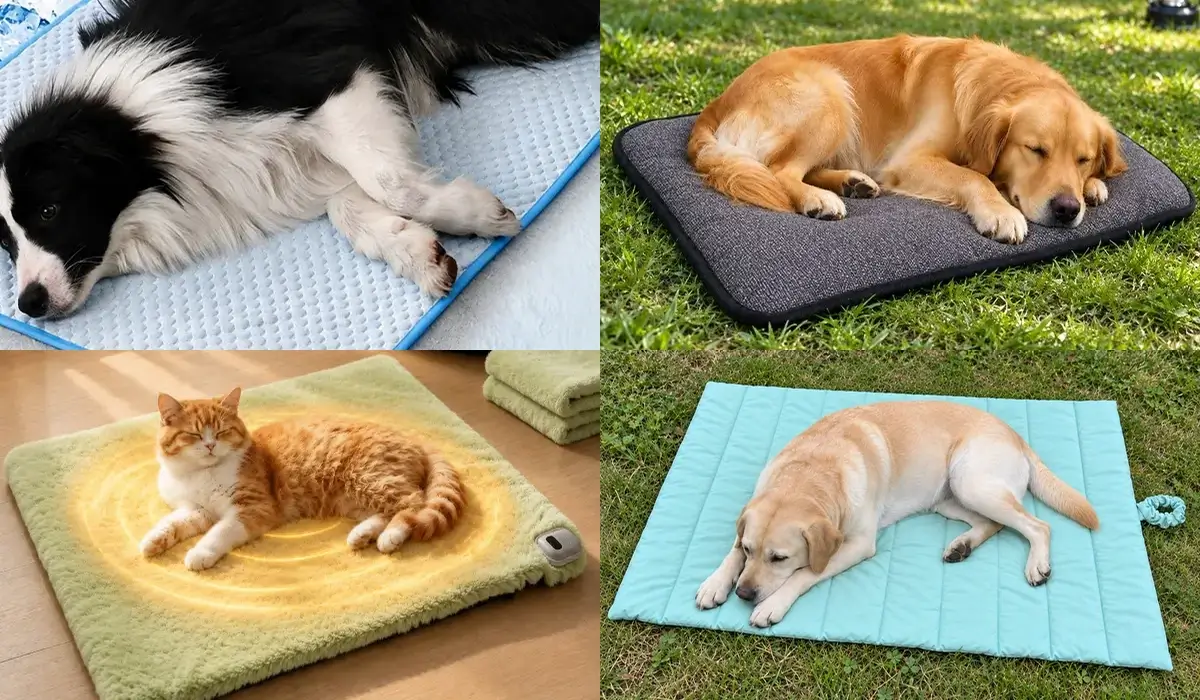
Thin mats carried on camping trips and thick beds used for everyday indoor rest have different material priorities. Summer cooling mats and winter heated mats also require different constructions.
A reliable approach is to define the intended use, select the surface fabric, support layer, functional layer, and backing, and then validate the complete sample. No single fabric or filling determines the comfort, durability, or washability of the finished product. This article covers material requirements for different uses, performance differences between surface fabrics, inner layers, and backings, and the distinctions between water-repellent, waterproof, and machine-washable materials. It also uses four Uwin pet mats to illustrate the functions and applications of different constructions.
1. Define the Needs the Product Will Address
Before sourcing, requirements can be expressed in one specific sentence. For example: “Develop a foldable dog mat that can be machine washed as a whole and used for temporary rest during travel.” This gives suppliers a clearer basis for proposing a solution than simply requesting “durable, comfortable materials.”
| Product Positioning | Required Functions | Suitable Material Options |
|---|---|---|
| Everyday indoor rest | Soft surface, cushioning, support, easy cleaning | Fleece or plush covers; polyester fiberfill (PP cotton) for softness; PU foam for cushioning and support; non-slip backing |
| Travel and temporary outdoor rest | Lightweight construction, foldability, water repellency, backing grip | Water-repellent polyester or Oxford fabric; spray-bonded polyester batting for lightweight padding; EVA foam for lightweight cushioning; non-slip dot backing |
| Inflatable camping bed | Abrasion resistance, air retention, cushioning, compact storage | Oxford fabric cover; sealed TPU or PVC inflatable bladder with a compatible valve |
| Summer cooling mat | Cool-to-the-touch surface, breathability, moisture management | Cooling fabric cover; breathable mesh or spacer fabric; optional thin padding selected to suit the overall cooling design |
| Winter warming or heated mat | Soft warmth, insulation; controlled heat for powered versions | Fleece or plush cover; polyester batting or EVA foam insulation layer; low-voltage heating components for powered versions; optional encapsulated PCM layer for thermal storage |
The pet’s weight and dimensions when lying down should also be recorded. A “suitable for large dogs” label is less useful than clearly defined dimensions and loading conditions. Mats with the same initial thickness may compress to different thicknesses under different weights.
2. Materials and Performance Across Four Pet Bed Mat Layers
Surface Fabric: Contact Feel, Cleaning, and Durability
The surface fabric is the part that directly touches the pet. Buyers should compare fiber composition, fabric construction, fabric weight, finishing treatments, and care requirements.
For example, “polyester” describes fiber composition, while “Oxford” describes a type of fabric; they are not mutually exclusive options. Oxford fabric can be made from polyester or nylon, and its performance also depends on fabric density and coatings. “Ice silk” is a common commercial term, typically referring to fabrics made from nylon, polyester, viscose, or blends of these fibers. The exact fiber composition should still be requested when obtaining a quote.
| Common Surface Fabric | Potential Applications | Effects on Pet Comfort and Cleaning |
|---|---|---|
| Woven polyester fabric | Travel mats, washable everyday mats | Tightly woven fabrics without a pile make loose hair easier to remove because hair is less likely to become entangled in a pile; rough or loosely constructed fabrics may trap hair |
| Oxford fabric | Outdoor bed covers, products that prioritize abrasion resistance | Easier to wipe clean promptly after light splashes |
| Short-pile plush or faux rabbit fur | Indoor fall and winter mats | The pile creates a soft contact surface, while air between the fibers helps reduce heat loss; shed pet hair may become trapped in the pile, requiring brushing or vacuuming |
| Cooling fabric | Summer resting mats | Transfers heat away more quickly during initial contact, creating a cool-to-the-touch sensation |
| Coated or laminated fabric | Areas requiring protection against liquid penetration | A continuous water-blocking layer can reduce liquid penetration through the fabric into the filling |
Support Layer: Performance Under Weight Matters Beyond Thickness
Common constructions include fiberfill, foam, and inflatable support.
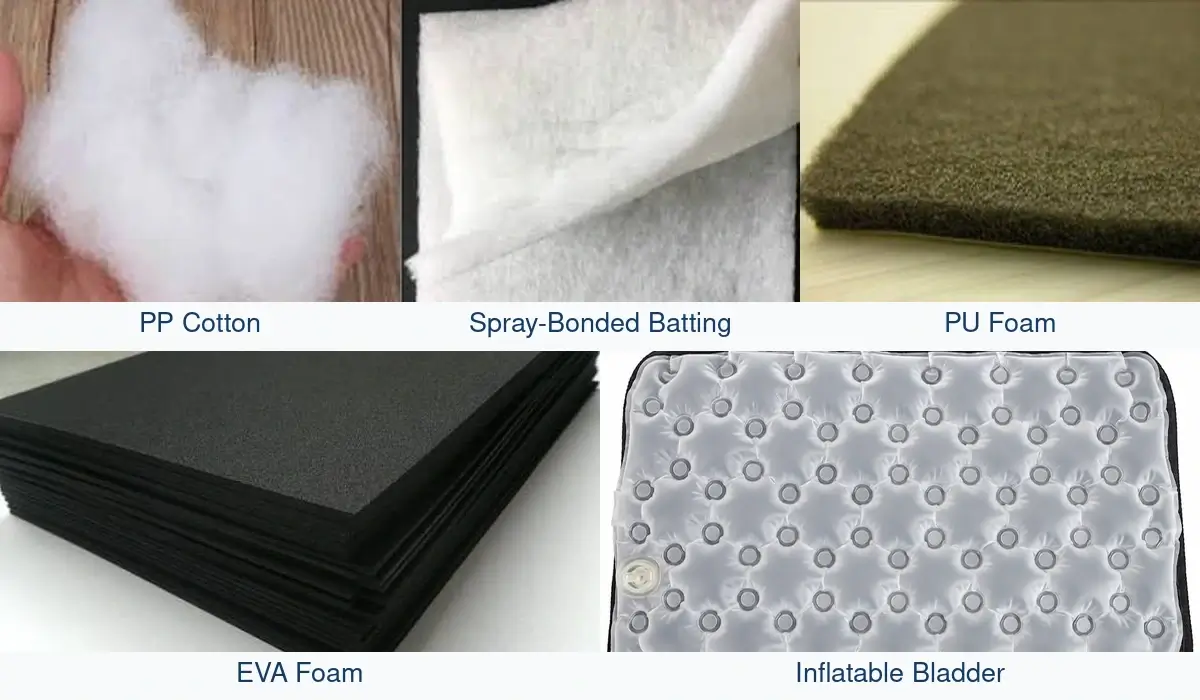
Polyester fiberfill, such as PP cotton and bonded batting: Lightweight, soft, and easy to fold, this filling suits travel mats and everyday soft pads. PP cotton is typically used for lofty filling, while bonded batting forms a sheet-like layer suited to thinner, foldable mats. These constructions emphasize softness and portability; how well they retain thickness under weight depends on the filling quantity and how it is secured.
Polyurethane foam (PU foam): Creates a cushioning layer with relatively uniform thickness and suits indoor pet beds. Conventional resilient foam rebounds relatively quickly after compression, while memory foam recovers more slowly and conforms to the body’s contours. Memory foam is often combined with a supportive foam base. Density affects weight and durability, but higher density does not necessarily mean greater firmness.
EVA foam is lightweight, closed-cell, and has low water absorption. It can serve as a cushioning or insulating layer in thin mats, making it suitable for portable mats and warming mat constructions. Compared with thick, soft bed foam, it generally places greater emphasis on low weight, separation from the floor, and shape retention.
Inflatable bladders commonly use TPU or PVC film, or corresponding coated fabrics, with sealed air chambers providing cushioning. Their main advantage is that they offer thickness when inflated while taking up less space after deflation, making them suitable for camping and travel beds. Firmness depends on both inflation level and air-chamber design.
Products positioned as orthopedic or therapeutic require separate supporting evidence; “thick” or “soft” alone does not justify such claims.
Functional Layer: Cooling, Insulation, Heating, and Heat Storage
These functions work differently:
| Function | Main Role | Common Points of Confusion During Sourcing |
|---|---|---|
| Cooling fabric | Improves the cool sensation on contact | Does not provide continuous active cooling |
| Insulation layer | Reduces heat transfer | Does not generate heat |
| Electric heating layer | Supplies heat when connected to a compatible power source | Component temperature is not the same as the surface temperature the pet touches |
| PCM, or phase change material | Absorbs, stores, and releases heat under suitable conditions | Does not independently generate heat |
Backing: Stability on the Intended Surface
Pet bed mat backings can use PVC-dotted fabric, silicone-dotted fabric, rubber, or TPE non-slip layers. PVC- and silicone-dotted fabrics have raised dots applied to a base fabric. The dots increase friction through contact with the floor while preserving the fabric’s flexibility and foldability, making these constructions suitable for pet mats that need to be packed away and washed. Rubber and TPE can form continuous or textured backing layers; their weight, flexibility, and grip depend on formulation and thickness.
Material selection should include stability checks on the intended tile, wood floor, or crate tray, along with checks for detached dots, cracking, and marks left on flooring after washing.
3. Differences Between Water-Repellent, Waterproof, and Machine-Washable Materials
Water-repellent fabrics commonly include polyester and nylon fabrics treated with a water-repellent finish, including corresponding Oxford fabrics. The finish makes the surface harder to wet and helps it handle light splashes. The names polyester, nylon, and Oxford alone do not mean the fabric is water-repellent.
Waterproof materials commonly include PU- or PVC-coated fabrics and fabrics laminated with a TPU waterproof membrane. The coating or membrane creates a barrier that reduces liquid penetration into the filling, making these materials suitable for outdoor bed covers or inner protective covers. Whether the complete mat is waterproof also depends on water-blocking construction at seams and zippers.
Common machine-washable options include polyester fabric, nylon fabric, and some polyester short-pile plush fabrics; suitable washable polyester fiberfill can also be used inside. These materials can be used in removable covers or whole-mat washable constructions, but machine washability still depends on dyeing and finishing, coatings, lamination, and how the filling is secured. A washable cover does not mean the foam, inflatable bladder, PCM pouch, or heating components can be machine washed with it.
These three properties can appear in the same product. For example, polyester fabric can receive a water-repellent finish while remaining machine washable under appropriate conditions, although repeated washing may reduce its water repellency.
5. Material and Application References: Four Uwin Pet Bed Mats
The following products illustrate four different construction approaches. Selection should reflect the intended use and be based on the final approved sample and specifications.
1. Dog Travel Mat: Lightweight, Foldable, and Easy to Clean
Uwin’s Dog Travel Mat uses a water-repellent polyester shell, bonded batting, and PVC-dotted backing. It measures 110 × 66 cm and weighs approximately 400 g. Whole-mat machine washability can be specified.
It suits lightweight resting needs during travel or temporary stops, with flexible filling that allows it to fold. Buyers should focus on its unfolded dimensions, packed size, filling stability, and shape after washing.
2. Waterproof Inflatable Outdoor Dog Bed: Separate Evaluation of the Cover and Inflatable Support
This Waterproof Inflatable Outdoor Dog Bed combines a removable cover with inflatable support. It uses Oxford fabric or customer-selected custom fabrics and packs away after deflation. Its main applications are camping and pet travel.
The Oxford cover provides an abrasion-resistant contact surface, while the waterproof treatment helps reduce the entry of ground moisture and light splashes. The inflatable bladder creates a cushioning layer that reduces direct contact with hard ground. This construction suits outdoor product development that prioritizes compact storage.
3. Pet Cooling Mat: Cooling Surface with a Removable Insert
Uwin’s Pet Cooling Mat combines an ice silk cooling surface with an 8 mm soft foam layer, providing a cool-to-the-touch feel and soft cushioning without electricity, added water, or refrigeration. The honeycomb-textured non-slip backing helps reduce movement on smooth floors. Both the cover and removable insert can be machine washed according to the care instructions, making pet hair and everyday stains easier to clean.
The product suits everyday summer rest for dogs and cats indoors, in pet beds, or in crates. It also suits pet brands and retailers developing reusable, washable summer cooling mat collections. Uwin offers custom sizes, colors, branding, and packaging.
4. Low-Voltage Heated Pet Mat: Complete Heating Construction for Fall and Winter Use
This Low-Voltage Heated Pet Mat uses a faux rabbit fur surface, heating layer, aluminum film, EVA insulation, and honeycomb-textured backing. It is available in two 5V-powered versions: heating only and heating with PCM.
It suits indoor fall and winter products that require powered heating. The PCM version adds heat storage and gradual heat release. Weight, construction, power requirements, and temperature-control requirements should be confirmed separately for each version.
6. Frequently Asked Questions
Is there one best material for all custom pet bed mats?
No. Travel products generally prioritize weight and storage, while beds for extended indoor rest place greater emphasis on support under weight and cleaning. Seasonal products also require validation of heating or cooling performance. Material combinations should follow the intended use.
Are thicker, softer mats always more comfortable?
Not necessarily. Relevant factors include whether the mat compresses too far under the intended weight, how it recovers, and whether its dimensions and construction suit the intended use. Thickness cannot replace support performance.
Can cooling, waterproofing, and machine washability be combined?
They can be combined as development goals, but the trade-offs across the complete construction need to be considered. Adding coatings, membranes, or filling may change heat and moisture transfer and drying performance. The finished sample ultimately needs to be validated.
Can an existing fabric test report be used for a new custom version?
The report first needs to be checked against the new version’s materials, colors, finishes, and construction. After a material or structural change, the conclusions still supported by the original report—and any need for additional testing—should be assessed.
For a custom project, buyers can provide the intended use, dimensions, target pet weight, cleaning method, functional requirements, and estimated quantity. Uwin can use this information to discuss material and construction options. During sample approval, surface feel, support, cleaning, and functional requirements can then be translated into specifications that both parties can verify.
What Is OEKO-TEX? Its System, Certifications & Standards
OEKO-TEX® is a system of testing, certification, and labeling standards for the textile and...
What Is TPU? Types, Applications, and Processing Techniques
TL;DR: TPU combines rubber-like elasticity with the processing capabilities of plastic. It can be...
Is TPU Toxic? Is It Suitable for Everyday Products?
The short answer is that TPU can be used in everyday products. Under normal temperatures and...
Four Pet Warming Mat Solutions from Uwin: Warmth, Heat Storage, and Use Cases
The Four Warming Mats at a Glance What they have in common: All four products are designed to give...