
EVA and PVC are common drawer liner materials used in kitchen drawers, cabinets, and shelving to help protect surfaces and reduce item movement. However, even when two products are both described as “non-slip, soft, and easy to clean,” they may perform differently in everyday use.
For example, embossed EVA drawer liners typically have a continuous sheet structure that keeps crumbs and residue on the surface for easy wiping. PVC foam mesh liners provide a soft, cushioned feel, but liquids and fine debris can pass through the openings. Beyond the material itself, thickness, texture, and overall construction also affect the user experience.
For brands, retailers, and importers developing or sourcing drawer liners, understanding these differences can help identify products that better suit their customers’ needs. This article compares embossed EVA drawer liners and PVC foam mesh liners in terms of structure, grip, cleaning, and material selection, and introduces Uwin’s manufacturing and customization options.
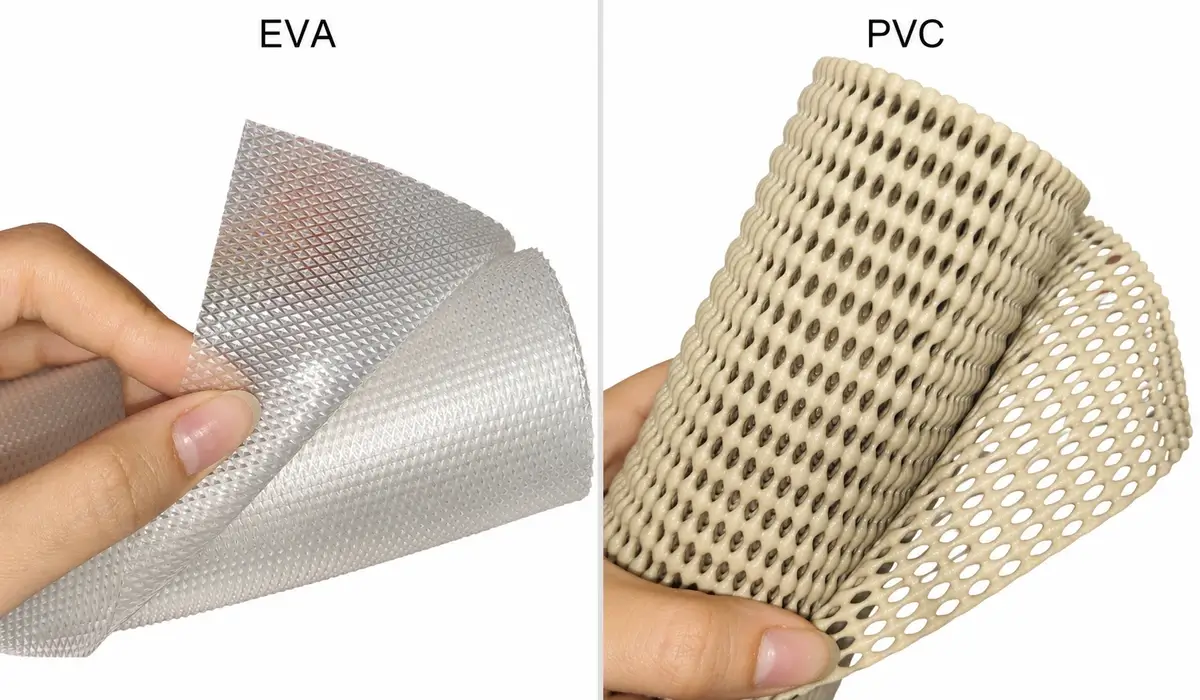
Structural Differences Between EVA and PVC Shelf Liners
EVA stands for ethylene-vinyl acetate, while PVC stands for polyvinyl chloride. These names identify the materials, but they do not tell you everything about how a finished drawer liner will perform.
PVC can be made into a continuous sheet or an open mesh structure. EVA products can also vary in feel and how they lie on a surface depending on their thickness, formulation, and texture. Before comparing two products, it helps to understand their specific construction.
Embossed EVA Sheets: Continuous Surface Coverage
An embossed EVA drawer liner is a flexible sheet that can be cut to fit drawers, cabinets, or shelves, adding a protective layer over the existing surface.
Its defining feature is a continuous surface with no openings running through the sheet. Small crumbs and residue generally stay on top rather than falling directly onto the shelf below.
The surface can also feature dot, diamond, bubble, or fine-grid patterns. These textures affect both appearance and how stored items contact the liner.
PVC Foam Mesh Liners: Foam Combined with Open Mesh
PVC foam mesh liners combine a foam layer with a reinforcing scrim, leaving open spaces in the mesh and providing a soft layer between stored items and the shelf.
Unlike a continuous sheet, the open mesh allows liquids and fine debris to pass through. It can provide cushioning, but it does not serve as a leakproof barrier.
These differences mainly come from continuous sheet versus open mesh construction. They should not be taken to mean that all EVA products block liquids or that all PVC products have mesh openings.
The Effect of Thickness and Foam Structure on Cushioning and Support
PVC foam provides a soft contact surface. Its cushioning and support depend on thickness, weight per unit area, foam structure, and the weight of the items placed on it. The support provided by an embossed EVA sheet also needs to be assessed based on its thickness and specific construction.
For small jars, drinking glasses, or items with narrow bases, check whether they sit steadily. For heavier items, observe how the liner responds under load.
When evaluating samples, compare more than feel and thickness—try them with the actual items they will hold. Softness should match the storage requirements; softer or thicker is not always more suitable.
How EVA and PVC Drawer Liners Provide Grip
Construction determines the liner’s basic form, while grip also depends on material formulation, surface texture, and how the surfaces meet. Non-adhesive liners generally rely on friction between the material and the contact surface to help reduce movement.
EVA Embossing and Surface Contact
Embossed EVA drawer liners are typically made using embossing rollers during sheet forming to create dot, diamond, or fine-grid patterns. These textures work with the material’s flexibility to help reduce item movement.
Different embossed patterns change how items contact the liner. When selecting a design, compare samples using actual glasses, jars, or utensils. Check whether the items sit steadily and whether they shift when the drawer is opened and closed.
PVC Coating, Foaming, and Surface Conformity
PVC foam mesh liners are typically made by coating a reinforcing scrim with a PVC paste, then heating it to create a soft, textured foam surface.
When items are placed on the liner, the foam compresses to some degree. Its ability to conform to the contact surface, together with surface friction, helps improve stability. Actual performance still depends on the formulation, firmness, foam structure, and item weight.
Check Grip at Both Contact Points
Drawer liner grip needs to be assessed at two points: between the items and the liner, and between the liner and the shelf.
Some samples may hold the items on top in place while the entire liner still shifts as the drawer opens and closes. This is why grip cannot be judged only by how pronounced the texture looks or how much friction you feel when touching the surface.
To compare samples, place both liners on the same type of shelf surface and use the same items. Then check whether the items and the liners move independently. Formulation, firmness, and the surface underneath can all affect performance, so results should be confirmed through testing for the specific project.
Cleaning EVA and PVC Drawer Liners
Beyond keeping items stable, ease of cleaning also affects everyday use. The main cleaning differences between these two products come from whether the surface is continuous and where residue collects.
Continuous EVA Sheets: Cleaning the Surface and Embossed Texture
Embossed EVA sheets have no openings running through them, so fine crumbs and residue generally remain on the surface for easy wiping. This makes the structure practical for kitchen drawers, utensil storage areas, and other spaces that need frequent cleaning.
When choosing an embossed pattern, compare whether residue tends to collect between the raised areas and how easily it wipes away.
A continuous sheet does not make the entire drawer waterproof. Water can still reach the surface underneath around cut edges or through gaps between sections. After a spill, lift the liner to check underneath, then clean and dry both surfaces before putting it back.
Open PVC Mesh Liners: Cleaning the Openings and Shelf Underneath
The open structure of a PVC foam mesh liner allows water, oil, and fine debris to pass through, so wiping only the top is not enough.
Lift the liner and check for residue in the mesh openings and on the drawer or shelf below. Wipe or rinse the liner according to its care instructions. Before putting it back, make sure both the liner and the surface underneath are dry.
Whichever structure you choose, follow the specific product’s cleaning instructions. A “washable” description alone does not mean the liner is suitable for machine washing or high-temperature cleaning.
Material Selection Tips for EVA and PVC Shelf Liners
Once the structural, grip, and cleaning differences are clear, you can match them to the intended use. Start by identifying where the liner will be placed and what it will hold, then decide which performance features matter most.
Key Differences Between the Two Liners
| Comparison Point | Embossed EVA Drawer Liner | PVC Foam Mesh Liner |
|---|---|---|
| Overall structure | Continuous sheet with an embossed surface | Foam layer with an open mesh structure |
| Contact surface | Available with different embossed patterns | Textured contact surface with mesh openings |
| Liquid protection | An intact sheet helps limit liquids passing directly through the liner, although water may still enter around the edges | Liquids can pass through the openings, so it does not serve as a leakproof barrier |
| Cushioning | Depends on thickness and the specific construction | Foam provides a soft, cushioned feel; actual support should be evaluated using samples |
| Everyday cleaning | Primarily wipe-clean, with checks underneath the liner | Wipe or rinse according to the care instructions, and clean the shelf underneath |
| Grip | Affected by embossing, formulation, contact surfaces, item weight, and other factors | Affected by the foam surface, mesh structure, formulation, contact surfaces, and other factors |
| Cutting and placement | Can be trimmed to fit drawers or shelves | Can be trimmed to fit drawers or shelves |
| Sourcing priorities | Thickness, embossed pattern, ability to lie flat, cleaning, and surface compatibility | Weight per unit area, thickness, mesh openings, compression recovery, and surface compatibility |
Choose the Structure for the Application
| Main Requirement | Option to Evaluate First | What to Check in Samples |
|---|---|---|
| Keep crumbs on the surface for easy wiping | Continuous embossed EVA sheet | Ease of cleaning the texture, water entering around the edges, and ability to lie flat |
| Provide a softer contact surface and cushioning | PVC foam mesh liner | Performance under load, item stability, and recovery |
| Use in areas where spills may occur frequently | Continuous sheet options | Whether additional edge protection or a leakproof design is needed |
| Remove regularly for cleaning and repositioning | Compare both options | Ease of cleaning, drying, and dimensional stability |
These two tables can help narrow down the options. Before making a final selection, samples should still be tried in the intended setting.
When developing a retail range, the two structures can also be offered as options for different needs. For example, one product can focus on continuous coverage and easy wiping, while another emphasizes a soft, cushioned feel, allowing customers to choose based on their storage habits.
Uwin’s Manufacturing and Customization Options
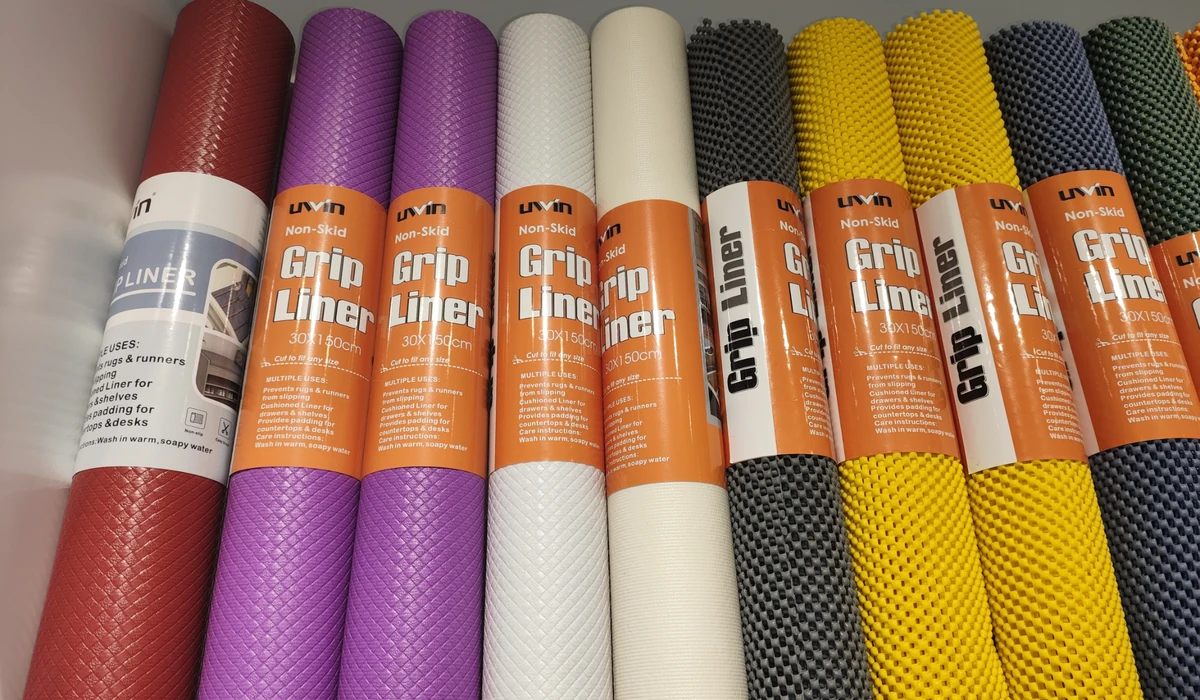
Uwin offers embossed EVA liners and PVC foam liners, with material structures, specifications, and packaging that can be adjusted to suit the application and brand requirements.
Custom Embossed EVA Liners
Uwin’s EVA Embossed Shelf and Drawer Liner Roll is available with different embossed patterns and customizable widths, lengths, thicknesses, colors, and packaging. Japanese silver-ion antibacterial additives can also be incorporated according to project requirements for refrigerator, cabinet, and other storage applications. For direct food contact, the relevant finished-product test documentation and conditions of use must be confirmed separately.
Custom PVC Foam Liners
Uwin’s PVC Foam Drawer and Shelf Liners are available in open mesh and solid-surface constructions, with customizable roll dimensions, weight per unit area, colors, and packaging. The non-adhesive design makes them easy to remove and reposition. If the project requires a liquid barrier, a solid-surface construction can be evaluated first, followed by sample testing to confirm its performance.
Brands, retailers, and importers can start by sharing the intended location, items to be stored, target dimensions, cleaning requirements, and estimated order quantity. Uwin can then work with them to determine the structure and specifications and arrange samples for comparison.
Frequently Asked Questions About EVA and PVC Drawer Liners
1. Are EVA drawer liners always more slip-resistant than PVC drawer liners?
Not necessarily. Slip resistance cannot be determined by the material name alone. It depends on surface texture, formulation, thickness, item weight, and the shelf underneath. Check both contact points separately: between the items and the liner, and between the liner and the shelf.
2. Can PVC mesh drawer liners stop liquids from reaching the surface underneath?
The open mesh version discussed in this article cannot. Liquids can pass through the openings. After a spill, remove the liner, then clean and dry the surface underneath. If a liquid barrier is needed, a solid-surface construction can be evaluated.
3. Can embossed EVA drawer liners be used in refrigerators?
Uwin’s product includes refrigerator storage applications. For each project, confirm the operating temperature, cleaning requirements, and whether direct food contact is involved. If food contact is required, review the test documentation for the specific finished product and intended use.
4. Can both types be cut to fit?
Yes. Both can be trimmed to fit drawers or shelves. When sourcing, you can also discuss roll widths, roll lengths, or precut sizes to better suit the intended sales channel.
5. Is a thicker drawer liner always better?
Not necessarily. Thickness should be considered alongside firmness, the items being stored, and the available space. Try samples with the actual items and observe their stability and performance under load rather than comparing thickness alone.
6. What information should buyers provide first when customizing drawer liners?
Start with the intended application, target dimensions, colors, preferred texture or construction, packaging format, and estimated order quantity. Any specific requirements for grip, cleaning, or materials should also be discussed before sampling.
Conclusion: Choose Based on Structure, Grip, and Cleaning Needs
Embossed EVA drawer liners and PVC foam mesh liners suit different needs. EVA sheets provide continuous coverage for easy wiping, while PVC foam mesh liners offer a soft, cushioned structure that also requires cleaning the shelf underneath.
Start by deciding whether the application needs continuous coverage or an open mesh structure. Then compare grip at both contact points and the cleaning and maintenance involved. Thickness, firmness, and embossing should be confirmed through sample evaluation using the items the liner will hold.
If you are developing a drawer or shelf liner collection, explore Uwin’s embossed EVA drawer liners and PVC foam liners, or visit Surface & Home Solutions to discuss applications, custom specifications, and sample requirements.
Four Pet Warming Mat Solutions from Uwin: Warmth, Heat Storage, and Use Cases
The Four Warming Mats at a Glance What they have in common: All four products are designed to give...
PVC Foam vs. EVA Foam: Which Material Is Better for Mats?
PVC foam is generally better suited to kitchen mats, doormats, commercial floor mats, and...
How Uwin Manufacturing Helps Brands Develop More Washable and Durable Mats
For brands, retailers, e-commerce sellers, and purchasing teams, post-wash complaints are rarely...
How to Prevent Floor Mats from Slipping on Carpet
Even if a mat stays firmly in place on hard flooring, it may still slide when placed on carpet....