
OEKO-TEX® is a system of testing, certification, and labeling standards for the textile and leather supply chains. It includes different standards for products, manufacturing facilities, and chemicals used in production.
Among these standards, STANDARD 100 focuses on harmful substances in textiles and textile products. MADE IN GREEN goes a step further by addressing manufacturing conditions and product traceability. STeP evaluates production facilities, while ECO PASSPORT focuses on chemicals, dyes, and auxiliaries used during manufacturing.
For brands, retailers, and importers, understanding the certification names is only the first step. When sourcing products, buyers also need to verify whether a certificate is valid, which materials or finished products it covers, and whether the products being ordered fall within the certified scope.
This is especially important for multilayer products containing fabrics, cushioning layers, non-slip backings, or printed surfaces. A certificate covering only the fabric does not automatically mean the entire finished product is certified.
What Is the OEKO-TEX Certification System?
OEKO-TEX® is a system of testing, certification, and labeling standards for the textile and leather supply chains. Among its standards, STANDARD 100 is one of the most widely recognized, focusing primarily on harmful substances in textile products. However, if you want to understand how a factory manages environmental issues, what working conditions are like for its employees, or whether raw materials come from organic farming, you need to look at other relevant certifications and supporting documentation.
That’s why, when you see a product labeled “OEKO-TEX certified,” it’s worth checking the full certification name. STANDARD 100, MADE IN GREEN, STeP, and ECO PASSPORT are all part of the OEKO-TEX system, but each focuses on a different aspect of the supply chain.
Key Differences Between OEKO-TEX Certifications and Labels
The following table highlights six certifications and labels commonly relevant to material selection, product sourcing, and manufacturing management. It is not a complete list of all OEKO-TEX services.
| Certification or Label | Main Scope | What Buyers Should Check |
|---|---|---|
| STANDARD 100 | Textile materials, components, and finished products | Harmful substance testing and the specific products covered by the certification |
| MADE IN GREEN | Textile and leather products | Product testing, manufacturing conditions, and traceability information |
| STeP | Manufacturing facilities and related operations | Environmental management, chemical management, social responsibility, and occupational health and safety |
| ECO PASSPORT | Chemicals, dyes, and auxiliaries | Whether chemicals used in production meet the relevant requirements |
| LEATHER STANDARD | Leather materials and finished leather products | Harmful substance testing for leather products |
| ORGANIC COTTON | Cotton and related products | Organic cotton verification, supply chain traceability, and harmful substance testing |
STANDARD 100: Testing Textile Products for Harmful Substances
STANDARD 100 applies to different stages of textile production, from yarns and fabrics to finished products.
It primarily tests for substances that may pose risks to human health, including formaldehyde, heavy metals such as lead and cadmium, certain carcinogenic or allergenic dyes, phthalates (some of which are used as plasticizers), PFAS (per- and polyfluoroalkyl substances), and pesticide residues.
The standard divides products into four classes based on their intended use: baby and toddler products, products with direct skin contact, products without direct skin contact, and decorative textiles. Products intended for babies and toddlers are subject to the strictest requirements.
To obtain certification, products and their applicable components must undergo laboratory testing. The levels of regulated harmful substances must remain within the limits specified for the relevant product class, and all other applicable requirements must also be met.
This does not mean certified products are completely free of chemicals. It means they meet the harmful substance safety requirements established by the standard.
MADE IN GREEN: Connecting Product Testing With Manufacturing Information
MADE IN GREEN is a traceable product label that addresses not only harmful substance testing but also environmental and social responsibility requirements in manufacturing.
To qualify for the label, products generally need an eligible certification, such as STANDARD 100 or LEATHER STANDARD, along with the required STeP certification for relevant production facilities and verified supply chain traceability information.
Consumers and buyers can scan the QR code or enter the product ID to view information about the product’s manufacturing origins and related production details.
Having a STANDARD 100 certificate alone does not qualify a product to use the MADE IN GREEN label.
STeP: Evaluating Manufacturing Facilities
STeP stands for Sustainable Textile and Leather Production. It is designed for textile and leather manufacturing facilities.
The certification evaluates six areas: chemical management, environmental performance, environmental management, social responsibility, quality management, and health and safety.
For example, it examines how a factory manages chemicals, handles wastewater, and protects workers’ health and safety.
STeP helps buyers better understand how a manufacturing facility is managed. However, STeP certifies production facilities rather than individual products, so certification of a factory does not mean that every product it manufactures is STANDARD 100 certified.
ECO PASSPORT: Evaluating Chemicals Used in Manufacturing
ECO PASSPORT focuses on chemicals used in textile and leather production, including dyes, printing inks, finishing agents, and other chemical auxiliaries.
It provides information at the chemical input stage of manufacturing. Through chemical ingredient screening and relevant testing, it evaluates whether these chemicals meet the applicable requirements.
This helps manufacturers reduce potential harmful substance risks beginning with material selection and production.
However, using ECO PASSPORT-certified chemicals does not automatically make the finished product STANDARD 100 certified. The finished product must still undergo the required evaluation and testing.
LEATHER STANDARD and ORGANIC COTTON: Certifications for Specific Materials
LEATHER STANDARD focuses on harmful substance testing for leather materials and leather products. It evaluates potentially harmful substances, including formaldehyde, heavy metals, and certain hazardous dyes, with applicable limits determined by the product’s intended use and type of contact.
ORGANIC COTTON combines organic cotton verification, supply chain traceability, and harmful substance testing.
For example, a garment marketed as being made with organic cotton needs supporting documentation verifying the cotton’s origin and compliance with the relevant certification requirements.
The certification therefore addresses not only whether the cotton was organically grown, but also the safety and traceability of the finished product.
Why Do Buyers Pay More Attention to STANDARD 100?
For buyers sourcing clothing, home textiles, baby products, and similar items, product safety and the ability to meet customer requirements are important purchasing considerations.
OEKO-TEX® STANDARD 100 directly evaluates harmful substances in finished products and their components, including formaldehyde, heavy metals, and certain hazardous dyes.
Compared with certifications that primarily assess factory management or manufacturing chemicals, STANDARD 100 provides more direct information about whether a specific product meets the relevant harmful substance safety requirements.
For brands, retailers, and importers serving European and North American markets in particular, STANDARD 100 can serve as a useful reference for supplier screening, product risk assessment, and quality audits.
The Four OEKO-TEX STANDARD 100 Product Classes
STANDARD 100 divides products into four classes based on their intended use. In general, the closer the contact with the skin and the more sensitive the intended users, the stricter the applicable requirements. [1]
| Product Class | Main Application | Official Examples or Description |
|---|---|---|
| Product Class I | Baby and toddler products | Products for babies and children up to 3 years old; the strictest requirements |
| Product Class II | Products with direct skin contact | Bedding, for example |
| Product Class III | Products without direct skin contact | Certain types of outerwear |
| Product Class IV | Decorative and related home textiles | Curtains, for example |
These classes are not rankings of durability or overall product quality.
A decorative textile and a baby product are designed for different types of contact and use. Therefore, a lower class number does not necessarily mean that a product is better in every respect.
How to Verify an OEKO-TEX Certificate
To verify a supplier’s certificate, visit the official OEKO-TEX website and open the Label Check tool.
Enter the certificate or label number, or scan the QR code on the product label.
Certificate and label numbers are case-sensitive. If no result appears, first double-check the number you entered. You can then contact the supplier, OEKO-TEX, or the issuing certification institute for confirmation.
A missing search result alone is not sufficient evidence that a certificate is fraudulent.
It is also a good practice to record the date of verification and save the results.
If certain details are not visible in the public search results, request the complete certificate and, when necessary, confirmation from the issuing institute. Do not assume that unlisted products or materials are covered.
Which Uwin Products Are OEKO-TEX Certified?
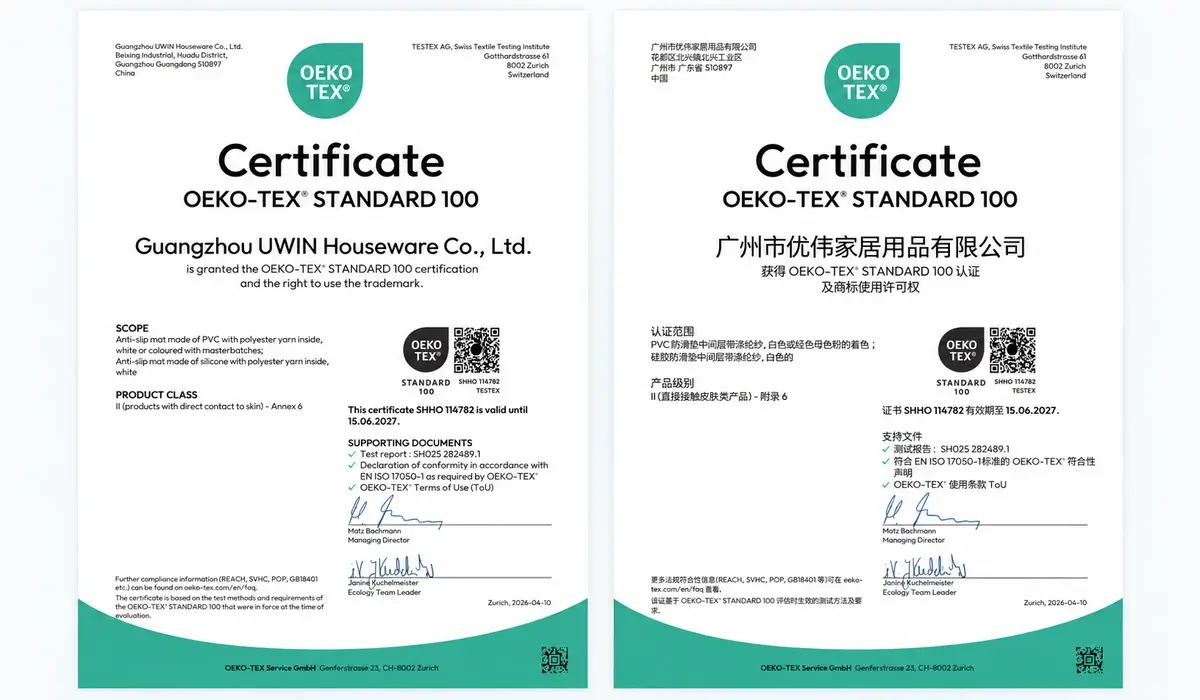
Uwin has obtained OEKO-TEX® STANDARD 100 certification (Certificate No. SHHO 114782) for certain non-slip mat products.
The certified scope includes:
- PVC non-slip mats with internal polyester yarns, available in white and colors produced using color masterbatch.
- White silicone non-slip mats with internal polyester yarns.
The certificate was issued by TESTEX, a Swiss textile testing and certification institute, and is valid until June 15, 2027.
These products meet the relevant harmful substance testing requirements for Product Class II (products with direct skin contact).
For brands, importers, and retailers, this certification provides independent third-party evidence to support safety assessments of the specified products.
FAQ About OEKO-TEX
Is OEKO-TEX the Same as STANDARD 100?
No. OEKO-TEX includes several certifications and labels, while STANDARD 100 is one of its standards specifically focused on harmful substance testing in textiles.
When reviewing supplier documents, buyers should always check the full certification name to confirm which standard applies.
Is OEKO-TEX Safe?
Products certified under OEKO-TEX® STANDARD 100 have met the harmful substance safety requirements within the scope of the standard.
Testing covers substances such as formaldehyde, certain heavy metals, hazardous dyes, and plasticizers. Products are also divided into four classes based on intended use, with the strictest requirements applying to baby and toddler products.
However, certification does not mean a product is completely free of chemicals, nor does it guarantee that the product is risk-free under every possible condition of use.
Does OEKO-TEX Allow PFAS?
OEKO-TEX® STANDARD 100 prohibits the intentional use of PFAS (per- and polyfluoroalkyl substances).
PFAS have been used in textiles to provide water, oil, and stain resistance, but certain substances in this group may pose long-term health and environmental risks.
The standard restricts specific PFAS and also uses total fluorine testing to strengthen its controls.
Under the 2026 requirements, the total fluorine limit for regular products is 50 mg/kg, with additional individual limits for certain PFAS.
Therefore, certification does not necessarily mean that a product contains absolutely zero PFAS. It means the product must comply with the applicable restrictions, including the prohibition on intentional use and relevant concentration limits.
How to Get an OEKO-TEX Certificate?
To obtain OEKO-TEX certification, a company must first apply through an authorized OEKO-TEX testing institute.
The application generally includes information about the product’s materials, manufacturing processes, and other relevant details, along with samples for laboratory testing.
The institute determines the appropriate product class based on the intended use and evaluates whether the product meets the applicable harmful substance limits. A facility inspection may also be required as part of the certification process.
Once the testing, assessment, and other certification requirements have been successfully completed, the company can receive its certificate.
OEKO-TEX certificates are generally valid for one year. Companies must apply for renewal when the certificate expires, and changes to materials or manufacturing processes may require additional evaluation.
Can One Certificate Cover Multiple Product Models?
Yes, depending on the certified product scope.
The number of sales models alone does not determine whether a certificate covers a product. What matters is whether the specific materials, structures, and product variations are included within the certification scope.
Buyers should ask suppliers to clearly identify which models correspond to the certificate. If the scope is unclear, the issuing certification institute should be consulted.
Does Changing the Color or Print Require a Complete New Test?
Not necessarily.
The first step is to confirm whether the new color or printed version is already covered by the existing certification.
Any changes outside the original certification conditions should be reported to the certification institute. The institute will determine whether the changes can be covered and whether additional testing is necessary.
Buyers should not assume that a modified product is automatically covered by the original certificate. [9]
Does a Product Without an OEKO-TEX Certificate Mean It Is Unsafe?
No. A product without OEKO-TEX® STANDARD 100 certification is not necessarily unsafe.
Product safety can also be evaluated through other testing and certification systems.
For example, products sold in the European Union may be tested for compliance with applicable requirements under the REACH Regulation, including restrictions on certain substances such as lead, cadmium, and specific phthalates.
For textiles, buyers may also consider the bluesign system, including its bluepass product certification, which addresses chemical management and environmental and safety requirements in textile production.
Different standards serve different purposes and cover different requirements. Buyers should therefore review the appropriate test reports, certification documents, and compliance evidence based on the product’s materials, intended use, and target market.
Does OEKO-TEX Allow Flame Retardants?
OEKO-TEX® STANDARD 100 does not prohibit every type of flame retardant, but it does impose strict requirements on their use.
Flame retardants are commonly used in curtains, upholstery fabrics, and other products designed to reduce fire risks.
Certain flame-retardant substances that present potential health concerns are restricted or prohibited. Other flame-retardant materials or finishing agents may be used in certified products if they pass the required OEKO-TEX assessment and meet the applicable testing requirements.
Therefore, STANDARD 100 certification does not necessarily mean that a textile product contains no flame retardants. It also does not mean that the product has passed flammability or fire-performance testing.
Discuss Your Product and Testing Requirements With Uwin
If you are sourcing custom mats, home products, or pet products, you are welcome to share your target market, intended application, material construction, and certification requirements with Uwin.
Please also let us know whether you need raw material documentation, finished-product certification, or test results for specific product functions.
This information helps us discuss material selection, product specifications, and testing requirements together as part of the same development project.
Contact Email: info@uwinmats.com