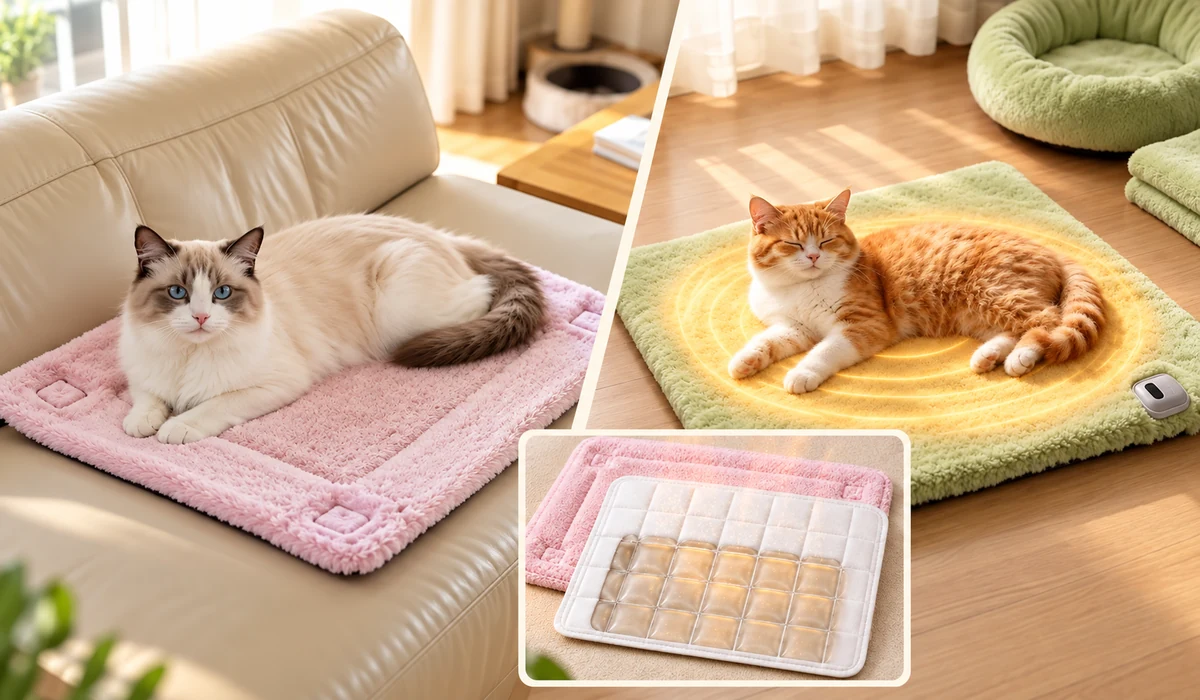
The Four Warming Mats at a Glance
What they have in common: All four products are designed to give pets a more comfortable place to rest in fall and winter. They share a soft faux rabbit fur surface, a quiet aluminum film layer, an EVA layer that helps separate pets from cold floors, and a honeycomb-patterned non-slip backing.
How they differ: The basic warming mat slows heat loss without power or advance preparation. The PCM heat storage mat first absorbs heat, then gradually releases it without needing to stay plugged in during use. The low-voltage heated mat actively supplies heat when connected to power, but has no PCM layer. The low-voltage heated and heat storage mat combines active heating with phase change heat storage, providing warmth while powered and gradually releasing stored heat afterward.
| Solution | How it works | Does it need power? |
|---|---|---|
| Basic Warming Mat | Its surface and insulating layers slow the loss of existing heat. It does not actively generate heat. | No |
| PCM Heat Storage Mat | The phase change material absorbs heat from its surroundings or a specified heat source, then releases the stored heat as temperatures change. | No |
| Low-Voltage Heated Mat | A heating element actively supplies heat when powered. It does not contain a PCM heat storage layer. | Yes, while heating |
| Low-Voltage Heated and Heat Storage Mat | The heating system actively supplies heat and charges the PCM layer. The layer then releases some of that stored heat as temperatures change. | Yes, during active heating. After the power is turned off, the PCM layer can release stored heat. |
Basic Pet Warming Mat: No Plug Needed, Ready to Use
The basic warming mat combines a faux rabbit fur surface, quiet aluminum film, an EVA layer that helps block cold from the floor, and a honeycomb-patterned non-slip backing. Each layer contributes to the surface feel, mat structure, or stability on the floor.
Its purpose is to slow heat loss rather than actively heat the mat. When a pet lies on it, the mat provides a soft resting surface and reduces direct contact with a colder floor. The actual warming experience depends on room temperature, flooring material, mat thickness, and the pet’s size.
This product addresses three common needs:
- Ready to use as soon as it is placed down: Suitable for a pet bed, crate, or favorite resting spot at home.
- A winter product that does not use additional electricity: Appeals to consumers who pay attention to everyday power use, since the mat does not need to be plugged in.
- Flexible placement around the home: Pet owners do not have to arrange their pet’s resting spot near an outlet. The mat can be placed in different indoor spaces, such as a living room or bedroom.
PCM Pet Heat Storage Mat: Stores Heat and Releases It Gradually
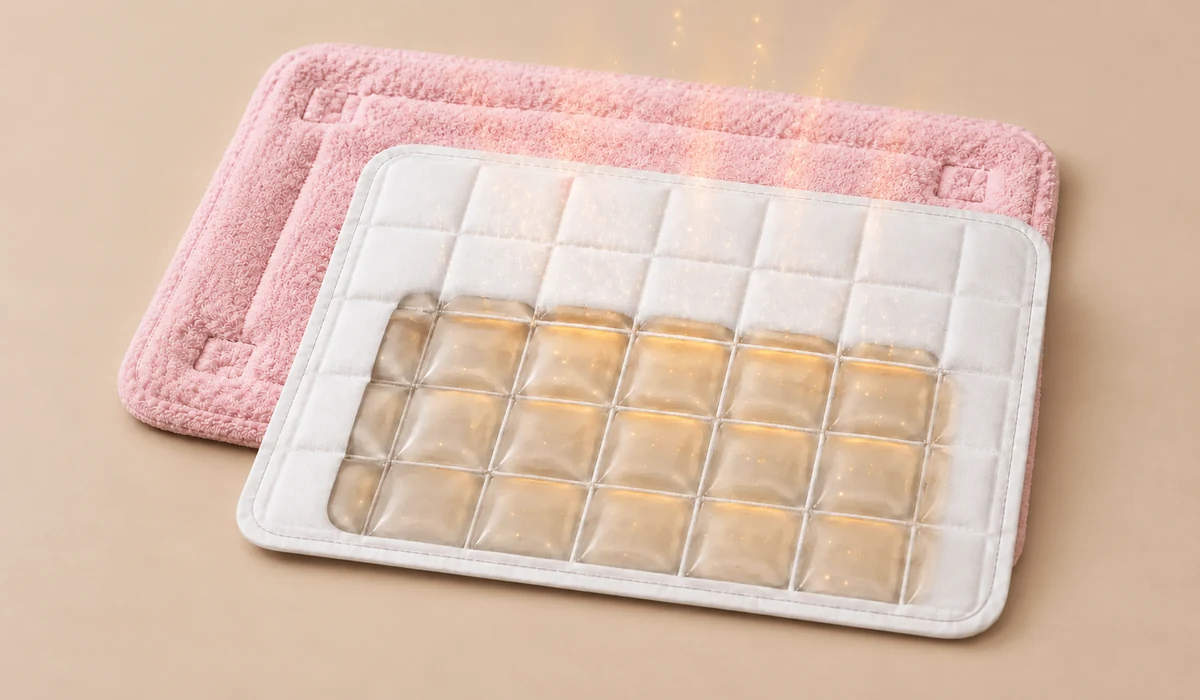
The second version adds PCM (phase change material) to the basic warming structure. A phase change material absorbs and stores heat within a specific temperature range. It then releases that heat as the material and surrounding temperature change. This process stores and releases existing heat; the PCM material does not generate new heat on its own.
A phase change material may also be described as a phase changing material, but “PCM” and “phase change material” are the terms used throughout this article.
That means the question “How long does it stay warm?” cannot be answered without knowing how the mat absorbed heat beforehand. If the PCM does not reach the conditions needed to store heat, its subsequent heat-release performance may differ from expectations.
Uwin’s product development team tested three independent samples, completing three full heat storage and release cycles per sample. Under the same ambient temperature conditions, the product showed approximately 2–3 hours of heat storage performance after charging. Actual duration may vary with room temperature, how fully the mat has stored heat, and where it is placed.
This product addresses the following needs:
- An upgraded fall and winter product line: Brands that already offer a basic warming mat can use the PCM layer as a clear structural difference and show the temperature curves of the two versions under the same test conditions.
- A simpler-looking pet resting area: Consumers can keep the resting spot free of exposed cords and continuously connected power cables.
Low-Voltage Heated Pet Mat: Turn It On When Needed and Adjust the Temperature
The third version adds a low-voltage heating system to the mat. Users can manually adjust the temperature setting, but the product does not contain a PCM phase change material layer. Unlike the basic mat, which slows heat loss, or the PCM mat, which must first absorb heat before releasing it, this version actively supplies heat to the mat surface when connected to a compatible power source.
This gives brands a clear product position built around “heat on demand.” It meets the needs of consumers who want to prepare a warm resting spot for their pets in a cooler indoor environment.
The key parts of this experience are how quickly the mat warms while powered, how evenly heat is distributed across its surface, and how the temperature control performs. After the power is turned off, the mat does not release heat from a dedicated PCM layer. It may retain some residual warmth for a time, but how quickly it cools depends on its structure and the surrounding conditions.
This product addresses three common needs:
- Active heating in cold weather: A basic warming mat can only slow heat loss; this version supplies heat when connected to power.
- Heating only when needed: Consumers can turn it on during colder periods instead of using the heating function all the time.
- Warmth while the mat is powered: It suits consumers whose main priority is active heating during use, rather than heat storage after the power is turned off.
Low-Voltage Heated and Heat Storage Pet Mat: Active Heating Followed by Lasting Warmth
The fourth version combines a low-voltage heating system with PCM heat storage material. The heating system supplies heat, while the phase change layer absorbs and stores some of it under suitable conditions. As temperatures change, the layer releases stored heat. The resulting experience depends on how well the two systems work together. The PCM’s phase change temperature, heat storage capacity, and performance across repeated cycles all matter.
Uwin’s product development team tested three independent samples, completing three full heat storage and release cycles per sample. After charging, the product showed heat storage performance lasting up to 6 hours at an ambient temperature of 24°C.
In Uwin’s internal testing, the team used three independent samples and completed three full heat storage and release cycles with each sample. After the product had fully stored heat, the team observed approximately 6 hours of temperature maintenance. Actual duration may vary with room temperature, how fully the mat has stored heat, and where it is placed.
This product addresses three common needs:
- Active heating followed by continued warmth: Suitable for households that want to turn on the heat before their pet rests and then have the mat’s temperature change more gradually afterward.
- Less time connected to power: Suitable for consumers who do not want to leave the heating function on throughout the entire period of use. How long the mat stays warm after being turned off depends on the stated test conditions.
- A more feature-rich fall and winter product: Suitable for consumers who value the combination of active heating and PCM heat storage and want to compare measured performance.
What Is the Distinct Advantage of Each Warming Mat?
| Solution | Advantage |
|---|---|
| Basic Warming Mat | Requires neither power nor heat charging. Its benefits are easy to explain, making it a suitable entry-level product for a fall and winter collection aimed at consumers who want to put a mat down and use it right away. |
| PCM Heat Storage Mat | Its ability to gradually release stored heat distinguishes it from a basic warming mat. It gives brands a functional product that does not need to stay plugged in during use and adds variety to their collection. |
| Low-Voltage Heated Mat | Active heating is an easy-to-understand feature. It suits consumers with access to a power source who want heat on demand, and brands can demonstrate its value by showing how the mat warms up. |
| Low-Voltage Heated and Heat Storage Mat | Combines active heating with temperature maintenance after heat storage. It can support a higher-positioned fall and winter product, with side-by-side test data showing how it differs from the heating-only version. |
Frequently Asked Questions
Q: What is the minimum order quantity?
A: The minimum order quantity for all Uwin pet products is 500 pieces.
Q: Does the basic warming mat heat up on its own?
A: No. Its structure slows the loss of existing heat, but it has no active heating element. The experience also depends on room temperature, the floor, and the pet.
Q: Does the PCM heat storage mat need to absorb heat first?
A: Yes. PCM stores and releases heat; it does not create heat from nothing. The heat may come from a cat’s or dog’s body temperature or from a heating source.
Q: Which warms up faster, the PCM heat storage mat or the low-voltage heated mat?
A: They work differently. The low-voltage version can actively supply heat when powered. The PCM version depends on how much heat it stored beforehand and the current ambient temperature. To compare their actual warming performance, review surface-temperature curves measured under the same conditions.
Q: How long does the heated and heat storage mat stay warm after it is unplugged?
A: The test result was 6 hours, but the actual duration depends on the conditions where it is used.
Q: Can all four warming mats be washed with water?
A: The outer cover can be removed and washed. The inner mat is not washable with water.
Q: Can the temperature of Uwin’s heated pet mat be adjusted?
A: Yes. Pet owners can adjust the temperature setting from 0°C to 45°C.
Q: What voltage does the low-voltage heating system use?
A: 5V.
Conclusion
Uwin factory can develop pet warming mat solutions around a brand’s target market, consumers’ use cases, and intended price range—from basic insulation and PCM phase change material heat storage to low-voltage heating and a combined heated and heat storage design. Brands can enter the market with one product or build a clearly positioned fall and winter collection around all four approaches.
During development, Uwin can discuss size, fabric feel, insulating structure, heating and heat storage functions with customers, then produce samples to compare the actual user experience. For functional versions, both parties can confirm the power supply, temperature controls, and tests needed for the target market before deciding which performance data to present publicly.
UWIN Invites You to Discover the Future of Home Goods at the 2025 Spring Canton Fair (Phase II)
Discover the latest in home goods innovation with UWIN at the 2025 Spring Canton Fair (Phase II)! Explore our new materials, designs, and IP-derived product solutions. Find us at Booth 16.3 E31-33 F12-14!
How to Prevent Mats from Slipping and Improve Customer Satisfaction
When a mat shifts forward, curls at the edges, or bunches up on carpet, consumers do not usually...
Dog Comfort on Long Car Rides: What Should Pet Businesses Consider?
A pet car window cushion that recently attracted attention and discussion on social media began...
Traveling With Pets: Product Insights for Brands and Retailers
The potential market for pet travel products is substantial. The American Pet Products Association...