
New product development sometimes begins with a customer’s feedback on an existing product.
While discussing a shelf liner project with a Chinese home goods brand, we learned that the customer wanted to develop a shelf liner with better slip resistance and a longer service life.
With this goal in mind, we moved beyond commonly used EVA and PVC materials and began developing a new TPE shelf liner. TPE combines rubber-like elasticity with the processing capabilities of thermoplastics. Its formulation and hardness can be adjusted to achieve different levels of softness, flexibility, and tactile feel. These characteristics gave us a material foundation for developing a soft, flexible shelf liner while allowing room to accommodate different requirements for feel, installation, and rolling.
We then combined the material with product thickness and surface texture design to develop a finished product for practical use. From TPE material evaluation to sample refinement and finished product approval, this article explains how Uwin translated customer requirements into specific product design decisions.
Customer Requirements: Finding a New Solution for Existing Shelf Liners
At the beginning of the project, the customer wanted to add a new shelf liner to its existing home organization collection, focusing on reducing shifting during everyday use, improving how the liner conforms to the installation surface, and making cleaning easier.
The product was intended primarily for kitchen cabinets, drawers, and shelves, with cabinet surfaces underneath and dishes, kitchenware, and everyday storage items on top. The customer wanted a liner that would be less likely to move when items were picked up or put away, while also feeling soft, being easy to cut to fit, and being convenient to remove for cleaning.
Through further discussions, we translated these requirements into specific development objectives:
| Customer Requirement | Practical Use or Purchasing Context | Development Challenge |
| Reduce shifting during use | Picking up dishes or pulling out storage bins can move the liner, requiring users to reposition it | Combine material selection and surface texture design to evaluate friction between the liner and cabinet surfaces, as well as between the liner and stored items |
| Provide softness and easy installation | Cabinets and drawers come in different sizes, so the liner needs to be trimmed and remain reasonably flat after installation | Balance material softness, thickness, and how well the liner lies flat after being unrolled |
| Make everyday cleaning easier | Kitchen storage areas may accumulate crumbs, dust, and small liquid spills | Consider how easily the surface texture can be cleaned and establish suitable cleaning methods |
| Support repeated use | Users want the product to remain functional after cleaning and repositioning | Check appearance and performance after repeated bending, cleaning, and installation |
| Support private-label purchasing | The customer needs the product to fit its existing collection, retail packaging, and target price | Incorporate color, dimensions, packaging, and cost requirements into the development plan |
Among these requirements, we prioritized reducing shifting when items were picked up or put away, while also considering softness, installation, and cleaning. We separately considered the liner’s stability against the cabinet surface and its contact with the items placed on top.
These requirements guided our material selection. We began evaluating TPE material and considered thickness, surface texture, and processing methods to find a finished product solution that would fit the customer’s product positioning.
Material Selection: Why We Chose TPE for This Project
We chose TPE for this shelf liner primarily because of its rubber-like flexibility and elasticity. These properties relate to the material’s internal structure: flexible regions deform under force, while supporting hard regions help maintain the overall structure and allow the material to recover its shape once the force is removed.
For slip resistance, TPE’s flexibility creates opportunities for closer surface contact. Under the weight of stored items, the material can deform slightly to conform to small surface irregularities, increasing actual contact. Deformation and energy loss as an elastic material slides can also contribute to frictional resistance. An appropriate TPE formulation can therefore give a shelf liner a grippy feel, although its final frictional performance still depends on hardness, formulation, and the contact surface.
For tactile feel, TPE combines softness with elastic recovery. When pressed or stretched, its flexible molecular chains can change configuration; once the force is removed, the material’s structure encourages recovery. This soft, springy response is the feel we wanted to achieve in the new product. When comparing it with EVA shelf liners, the specific degree of springiness also depends on the hardness, thickness, and foam structure of both products.
Product Design: Translating Requirements into Surface Texture, Thickness, and Product Format
After establishing the material direction, we translated the customer’s requirements into specific product details.
Surface Design: Addressing Contact and Shifting
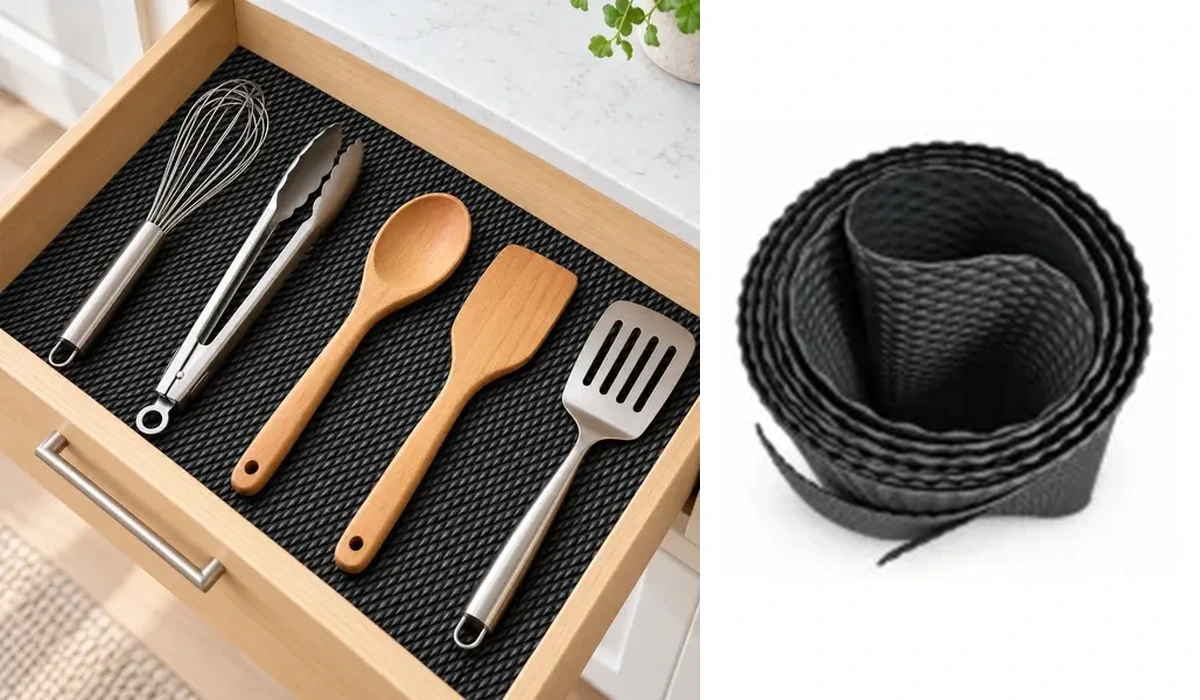
This TPE shelf liner uses different textures on its two sides: a regularly arranged raised diamond texture on the top and a fine recessed dimple texture on the underside. These surfaces address contact with stored items above and the cabinet surface below.
On the top, we combined the raised texture with TPE’s softness and elasticity, aiming to keep dishes, kitchenware, and storage items more stable and reduce sliding during everyday handling. On the underside, we used a shallow recessed texture and treated contact between the liner and cabinet surface as a separate design consideration, aiming to reduce the tendency for the liner to move along with items as they are picked up or put away.
We therefore focused on two related aspects of performance: whether items could remain stable on the liner and whether the liner could stay in position on the cabinet surface. Subsequent sample evaluations also examined these two contact relationships separately, using actual cabinet surfaces and storage items to observe movement during picking up, putting away, pushing, and pulling, and to check whether the two-sided texture design met expectations.
Dimensions and Packaging: Supporting the Customer’s Sales Channels
This TPE shelf liner comes in rolls, allowing users to cut it to fit cabinets, drawers, or shelves. For different product positioning needs, we can discuss roll width, length, and color with customers to balance ease of use and sales requirements.
For packaging, we can discuss options such as individually packaged rolls, branded labels, paper sleeves, or printed retail boxes based on retail, e-commerce, or wholesale requirements. We can also coordinate product information, cutting and cleaning instructions, barcodes, and outer carton markings.
We treat dimensions and packaging as part of finished product development and confirm them alongside sample specifications, helping align everything from product use and brand presentation to carton packing and transportation with the customer’s purchasing plan.
Performance Verification: Checking the Finished Product Against Development Objectives
After refining the samples, we used internal performance testing and practical installation evaluations to check whether this TPE shelf liner met the original development requirements. We considered both the material’s properties and how complete samples performed in cabinet and drawer settings, including their interaction with contact surfaces and stored items.
The project’s key evaluation areas included slip resistance, recovery after compression, flatness after installation, and appearance and condition after cleaning. Slip resistance evaluations separately considered friction between the liner and cabinet surface and between stored items and the liner. Elasticity and installation evaluations focused on recovery after compression, bending, and unrolling. For everyday maintenance, we cleaned samples using the proposed cleaning method and checked for visible deformation, surface damage, or other changes that could affect use.
Slip Resistance and Friction Performance
In internal friction testing, we took three measurements across the top surface of a gray TPE sample in the transverse direction. The coefficients of friction were 0.65, 0.63, and 0.61, with an average of 0.63. All three exceeded the ≥0.3 acceptance criterion used for this test.
The average coefficient of friction of 0.63 indicates frictional resistance between the sample’s top surface and the test contact material. In an everyday setting, the intended benefit is easy to understand: when a user picks up a dish, nearby storage items should be less likely to slide because of a slight bump.
Cleaning and Everyday Maintenance
This TPE shelf liner has a waterproof surface. Dust or small stains can be wiped away with a damp cloth. After cleaning, allow the liner to dry before putting it back, making everyday cabinet and drawer maintenance convenient.
The raised texture on the top means that items primarily contact the raised areas, reducing direct friction against the recessed areas and providing some protection against scuffing. To reduce damage during use, avoid scraping the liner with sharp objects and lift heavier items before moving them.
The New Product: Uwin TPE Shelf Liners
After completing [To be added: completed development and approval stages], we developed this TPE shelf liner.
In response to the original requirement for [To be added: core requirement], the finished product achieved [To be added: verifiable results]. The customer’s feedback was [To be added: feedback approved for public use; delete if unavailable].
The new product’s main specifications are summarized below:
| Item | Product Information |
| Product Name | TPE Shelf Liner |
| Material | TPE (thermoplastic elastomer) |
| Surface Design | Regularly arranged raised diamond texture on the top; fine, shallow recessed dimple texture on the underside |
| Dimensions | Customizable |
| Standard Colors | Gray/black; custom colors available upon consultation |
| Product Format | Rolls that can be cut to fit the installation space |
| Applications | Kitchen cabinets, drawers, shelves, and everyday home organization areas |
| Cleaning Method | Wipe everyday stains with a damp cloth and allow to dry before reinstalling |
| Optional Features | Antimicrobial options available upon consultation; specific requirements and testing scope must be confirmed separately |
| Packaging | Individually packaged rolls; branded labels, paper sleeves, or printed retail boxes can be discussed; carton quantities confirmed by order |
Buyers interested in finished product details or sample evaluation can visit our TPE Shelf Liner product page.
Discuss Your TPE Shelf Liner Project with Uwin
This TPE shelf liner began with a customer’s product requirements and reflects Uwin’s involvement from understanding those requirements to material selection and sample development.
If you are developing new shelf liners or looking to improve an existing product, we welcome your practical challenges, reference samples, or new product plans.
To make the discussion more specific, you can share:
- Application: Where the product will be installed and which surfaces and items it will contact.
- Development Objectives: The performance you want to improve and your highest-priority requirements.
- Product Specifications: Dimensions, thickness, color, product format, and packaging requirements.
- Market and Verification Requirements: Target sales regions and any existing testing or compliance requirements.
- Purchasing Plan: Expected quantity, target cost, and project timeline.
Based on this information, we will discuss material selection, sample proposals, and the next steps in development with you.
Frequently Asked Questions
Why did Uwin develop this TPE shelf liner?
We developed this TPE shelf liner in response to customer requirements for slip resistance, a soft feel, and convenient everyday cleaning. The product combines TPE’s flexibility with a two-sided texture design to help reduce sliding and shifting when items are picked up or put away. In internal testing, the gray TPE sample’s top surface had an average transverse coefficient of friction of 0.63, exceeding the ≥0.3 acceptance criterion used for that test.
How does this TPE shelf liner differ from Uwin’s existing shelf liners?
This new product uses TPE material, with a raised diamond texture on the top and a fine, shallow recessed dimple texture on the underside, combining a springy feel with the contact requirements of both surfaces. It has a softer, springier feel than EVA shelf liners and a longer service life than PVC shelf liners.
Does this product have a self-adhesive backing?
The current version does not have a self-adhesive backing. Please contact us when requesting a quote to discuss customization with an adhesive layer or other specific methods of securing the liner.
What can customers customize?
We can discuss customization of roll width, length, color, and branded packaging, including labels, paper sleeves, and printed retail boxes. Requirements for antimicrobial or other features can also be raised early in the process; specific feasibility, specifications, and testing arrangements must be confirmed separately. For changes to the material, thickness, or texture, we will further evaluate development and sampling requirements.
Can I request samples first?
Please contact us to discuss your sample requirements. Share your target dimensions, color, application, and shipping details, and we will confirm an appropriate sample proposal for evaluation, along with sample costs, shipping charges, and preparation time. Custom samples require confirmation of the specifications first.
What are the MOQ and production lead time?
The MOQ and production lead time depend on dimensions, color, custom features, packaging, and order quantity. Please provide your purchasing specifications and expected quantity. We will state the minimum order quantity, lead time, and when the lead time begins in our quotation so you can plan your purchase. Bulk orders can typically be ready for delivery in 30 days.
What Is OEKO-TEX? Its System, Certifications & Standards
OEKO-TEX® is a system of testing, certification, and labeling standards for the textile and...
What Is TPU? Types, Applications, and Processing Techniques
TL;DR: TPU combines rubber-like elasticity with the processing capabilities of plastic. It can be...
Is TPU Toxic? Is It Suitable for Everyday Products?
The short answer is that TPU can be used in everyday products. Under normal temperatures and...
Four Pet Warming Mat Solutions from Uwin: Warmth, Heat Storage, and Use Cases
The Four Warming Mats at a Glance What they have in common: All four products are designed to give...